


Walk up the narrow staircase of the old Dominican convent of San Marco in Florence and the first thing you meet is not a crowd of tourists but an angel. Gabriel kneels before Mary in soft ochre and rose, his wings still folded from flight. Beneath the fresco a small Latin inscription asks the passing friar to greet the Virgin with an Ave when he sees this image of the Annunciation. That single instruction tells you almost everything about what you are about to find in the dormitory beyond. This was never simply a museum in waiting. It was a house of prayer, and its paintings were built for people who were meant to kneel in front of them.
A convent remade by the Medici
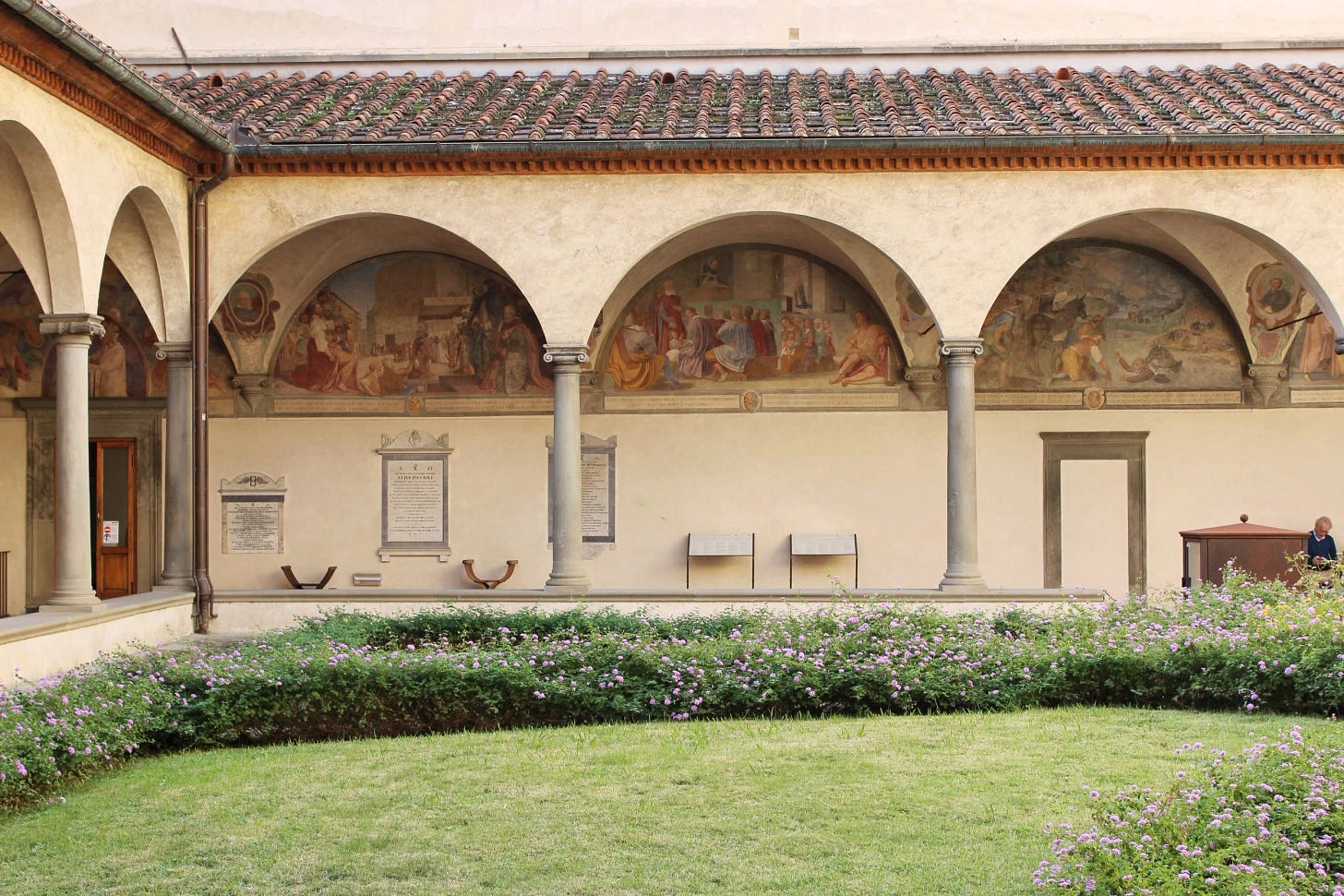
San Marco as we know it today exists because of Cosimo de’Medici. In 1436 a community of Dominican friars, Fra Angelico among them, moved from Fiesole into the old convent. Cosimo, who often retreated there himself for religious contemplation, engaged the architect Michelozzo to rebuild it and became the community’s great patron. According to Vasari, it was at Cosimo’s urging that Fra Angelico took on the enormous task of decorating the whole complex: the church, the chapter house, the cloister walks, and most intimately, the forty-four small cells where the friars slept, prayed and studied in near total silence.
Building proceeded corridor by corridor. By 1437 the first twenty cells, arranged along both sides of what became known as the Fathers’ Corridor, were already finished. They were soon frescoed under Fra Angelico’s direction. A second, later corridor was built for the novices, young men not yet fully professed. Their cells were larger than the fathers’ cells, meant to ease the novices gradually out of the comforts of the world, and were painted with a single repeated subject: Saint Dominic in adoration before the crucified Christ. Decades later, after Fra Angelico’s death, three of the rooms at the end of that same novices’ corridor became the private quarters of a far more turbulent friar, Girolamo Savonarola.
One fresco, one friar, one prayer
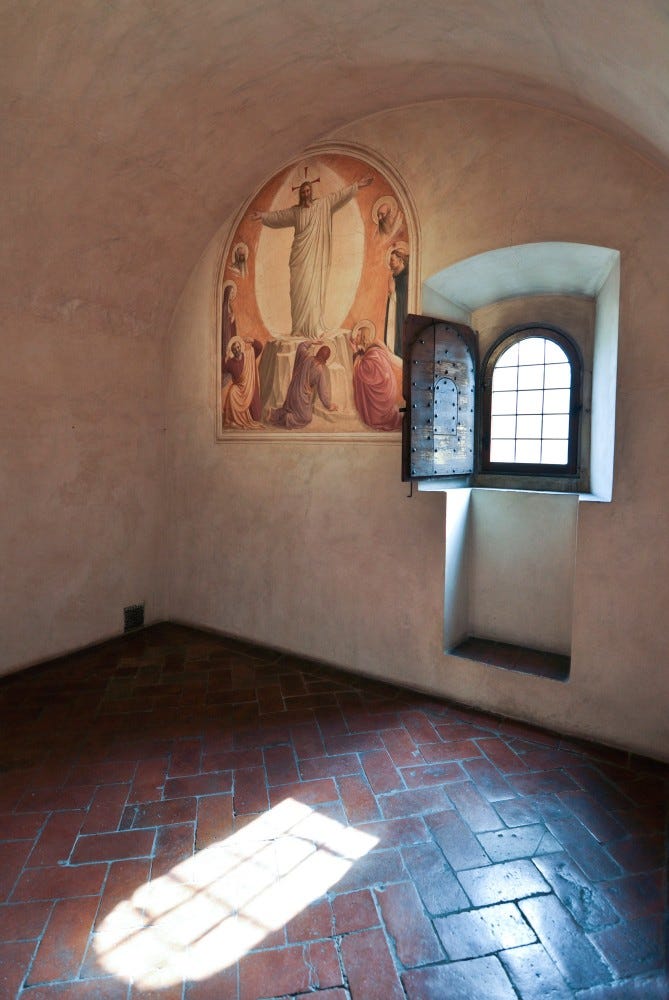
What makes the cells of San Marco unlike almost anything else surviving from the fifteenth century is their purpose. Each cell holds a single fresco drawn from the life and Passion of Christ, painted for the exclusive contemplation of the friar who slept there. These were not made for public display or for patrons to admire. Each one was meant for one man’s private meditation, night and morning, for as long as he occupied that room.
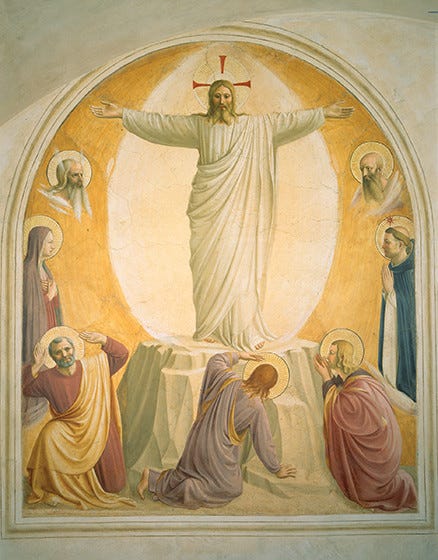
Scholars still debate how much of the actual brushwork is Fra Angelico’s own hand versus that of gifted assistants. The consensus, then and now, is that the whole cycle is essentially his conception, even where others helped him execute it. Quality does vary noticeably from cell to cell. The Annunciation in cell three and the Transfiguration in cell six are rightly counted among the true masterpieces, while a handful of other cells are more workshop than master. Even so, the theological unity of the whole scheme never wavers.
It helps to remember that these are not narrative decorations meant to be “read” the way a fresco cycle in a public church is read. Each image is stripped of incident and ornament, pared down to the essential moment, precisely because it was meant to anchor a single friar’s meditation on a single mystery, cell after cell, year after year.
Exploring the cells
Beginning at cell one, on the left-hand side of the Fathers’ Corridor, the paintings largely attributed to Fra Angelico’s own hand unfold like a private rosary in fresco:
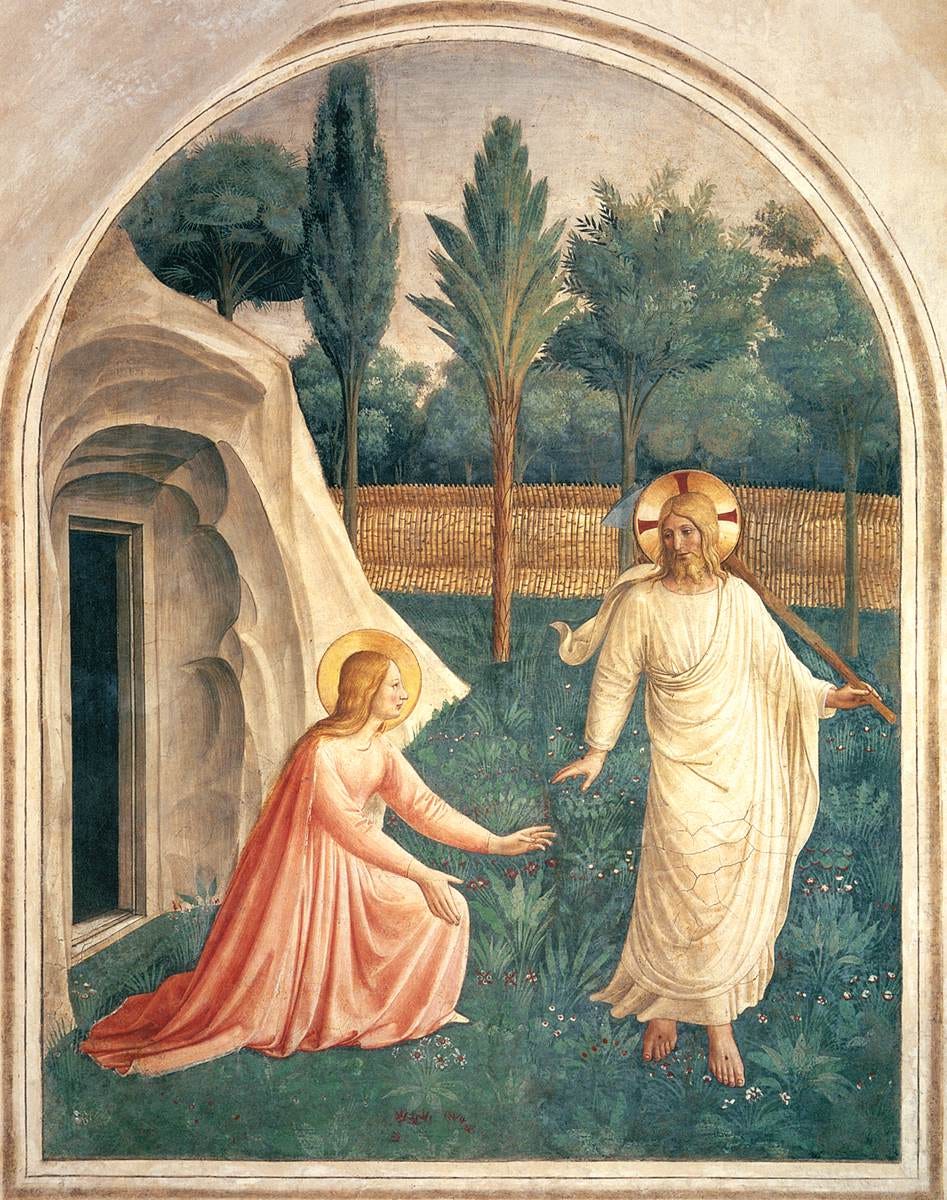
Cell 1, Noli me tangere. The risen Christ, still bearing the marks of the tomb, draws back from Mary Magdalene’s outstretched hand in a garden rendered almost weightless.
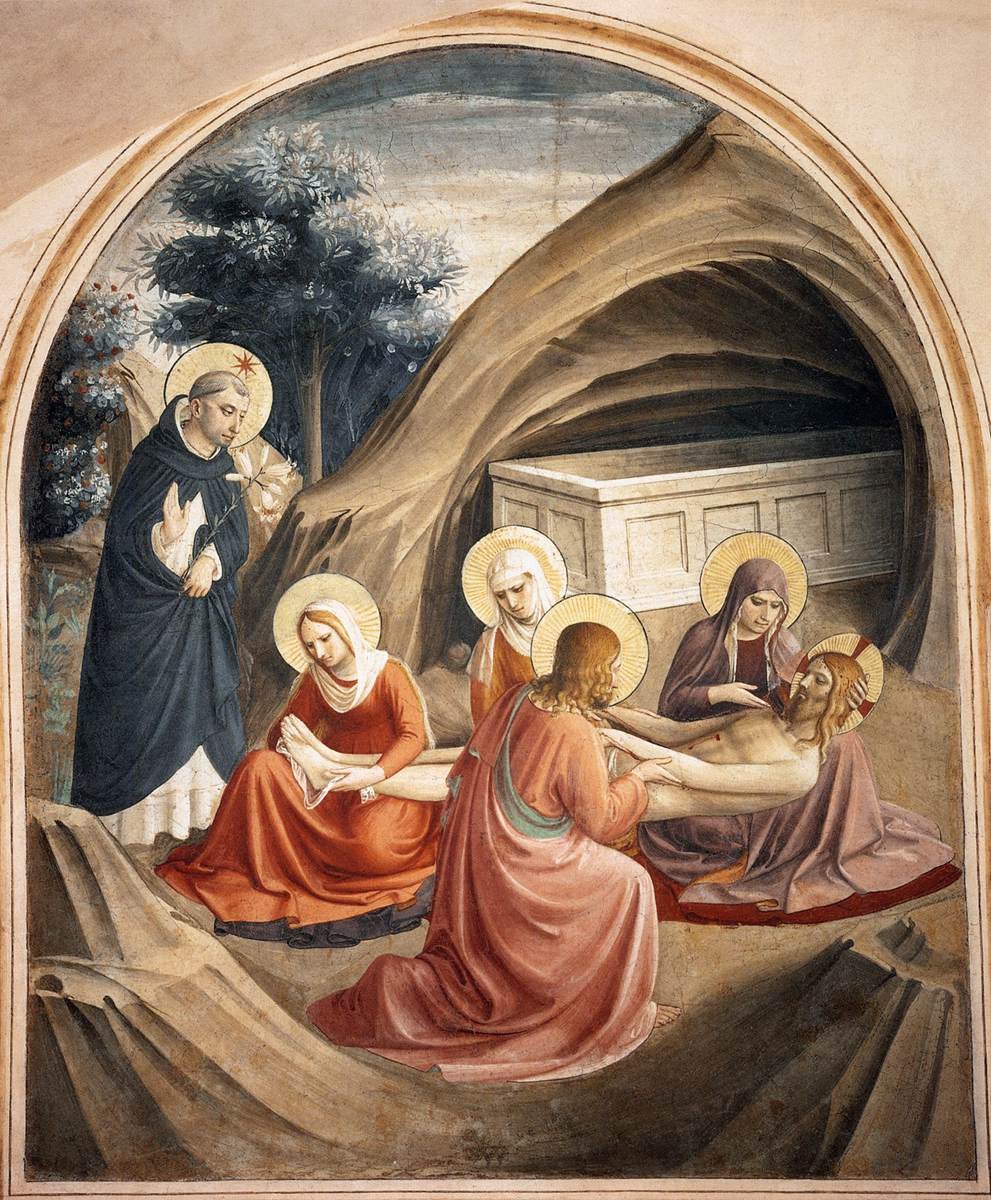
Cell 2, Lamentation over Christ. The dead Christ is laid across the knees of his grieving mother, flanked by the holy women and Saint Dominic himself, who kneels as witness at the foot of the cross-shaped composition.
Cell 3, The Annunciation. Considered one of the artist’s supreme achievements, it shows Gabriel and Mary meeting beneath a plain, cell-like loggia, its bare architecture deliberately echoing the very room in which the friar knelt to view it.
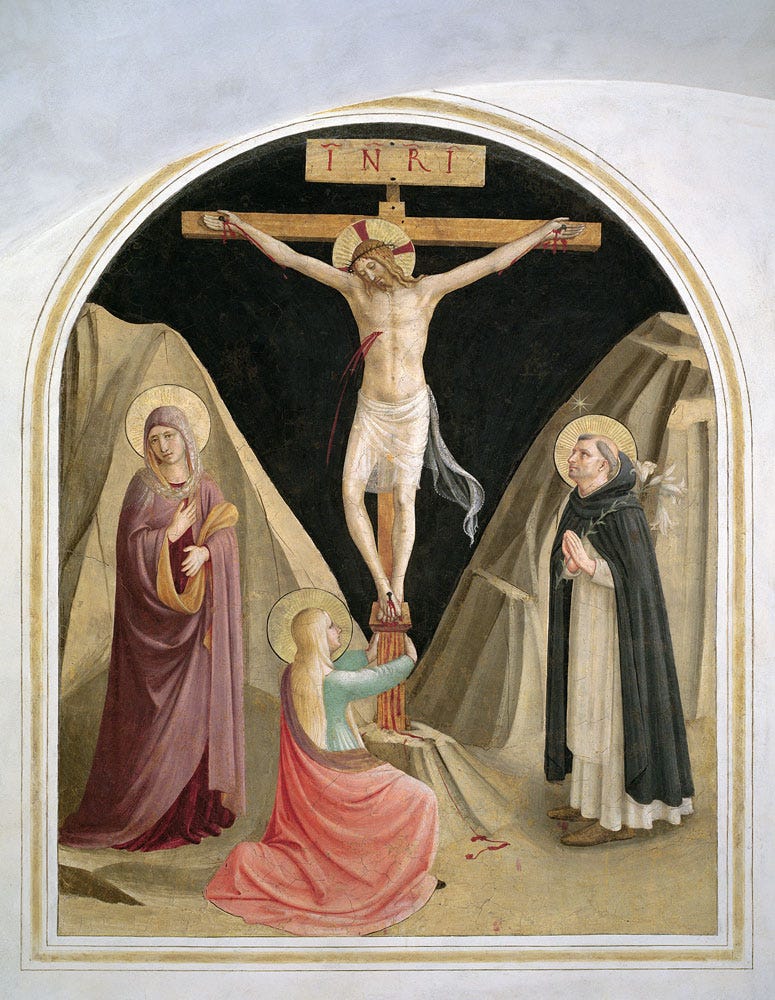
Cell 4, The Crucifixion. The Virgin and attendant saints gather at the foot of the cross.
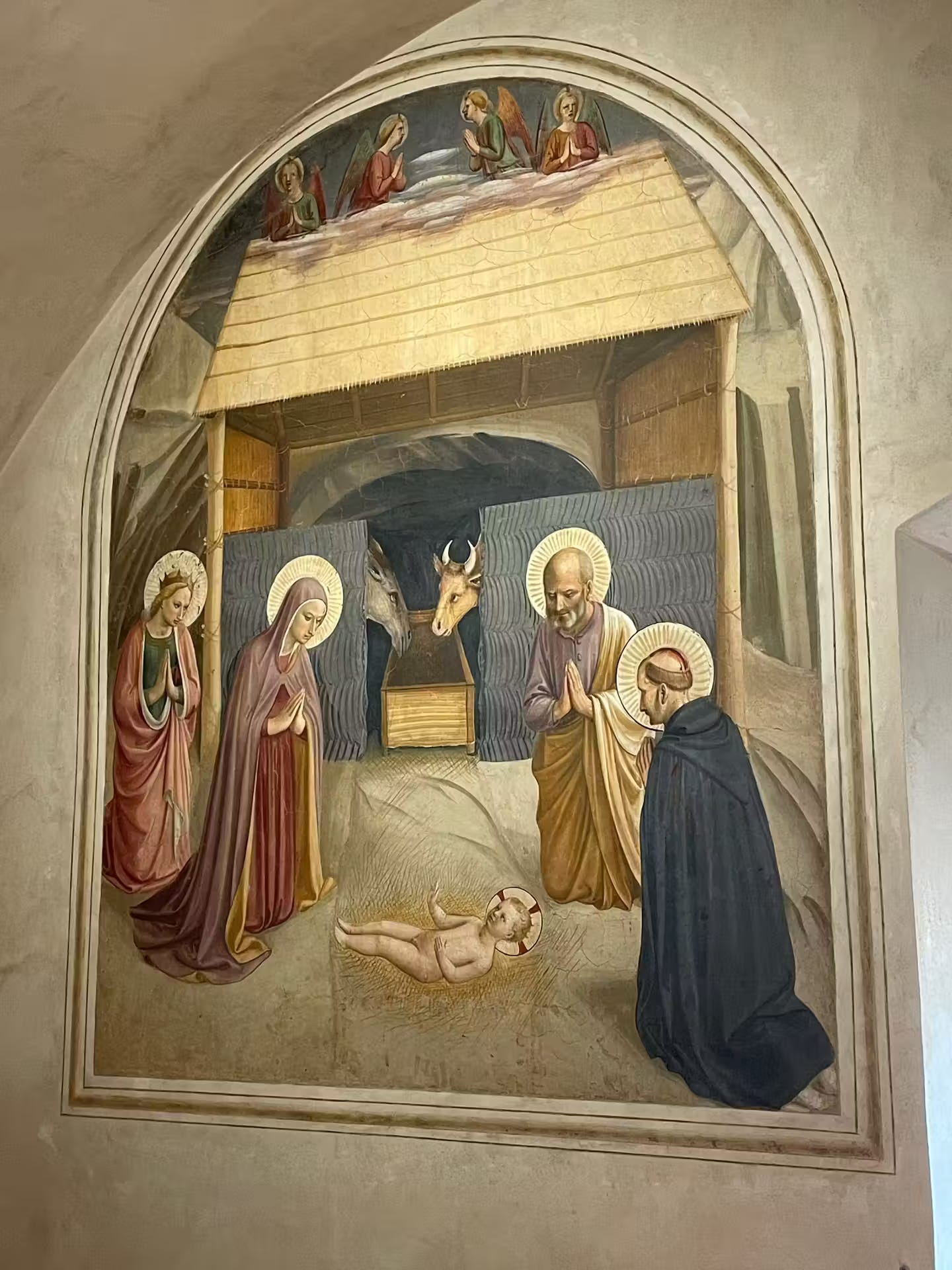
Cell 5, The Nativity. Mary and Joseph kneel in adoration over the newborn Christ in a rough stable shelter, with the ox and donkey looking on.
Cell 6, The Transfiguration. Christ stands in a mandorla of light on Tabor. Moses and Elijah flank him while Peter, James and John shield their eyes below. It is one of the boldest, most luminous compositions in the entire cycle.
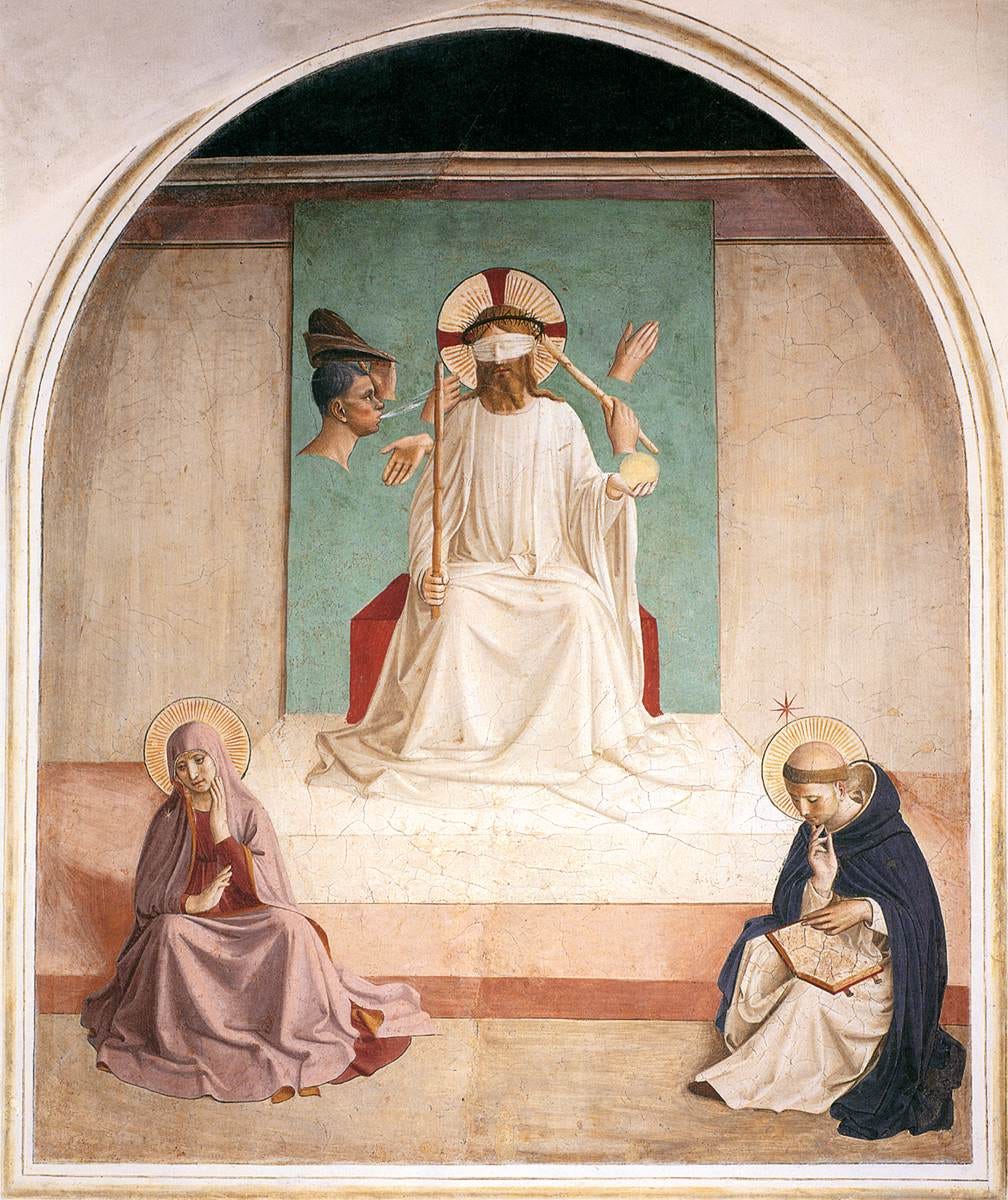
Cell 7, The Mocking of Christ. A strange, almost dreamlike image. A blindfolded Christ is struck by disembodied hands and spat upon by a floating head, while the Virgin and Saint Dominic sit quietly reading nearby, undisturbed witnesses to the Passion’s mystery.
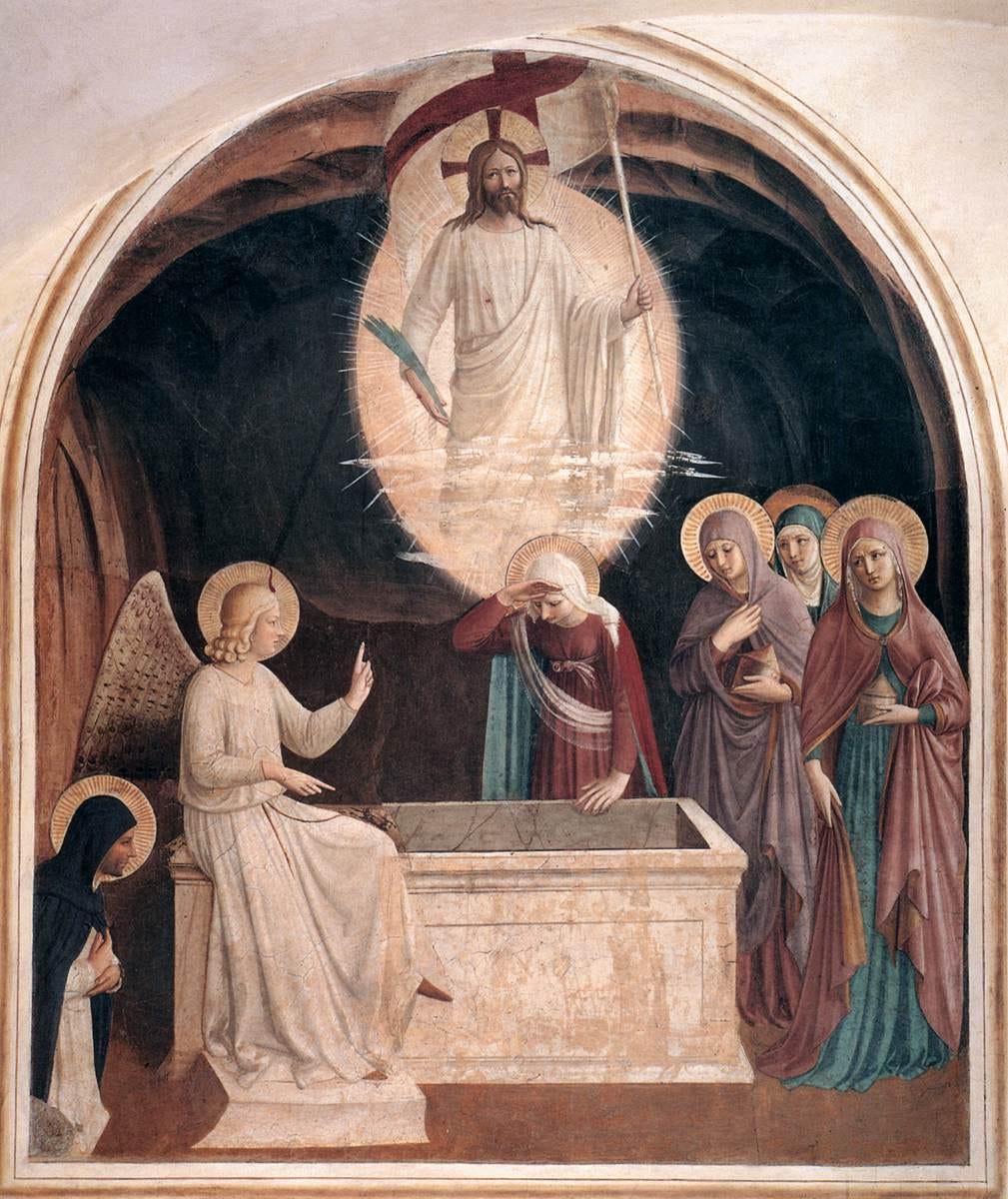
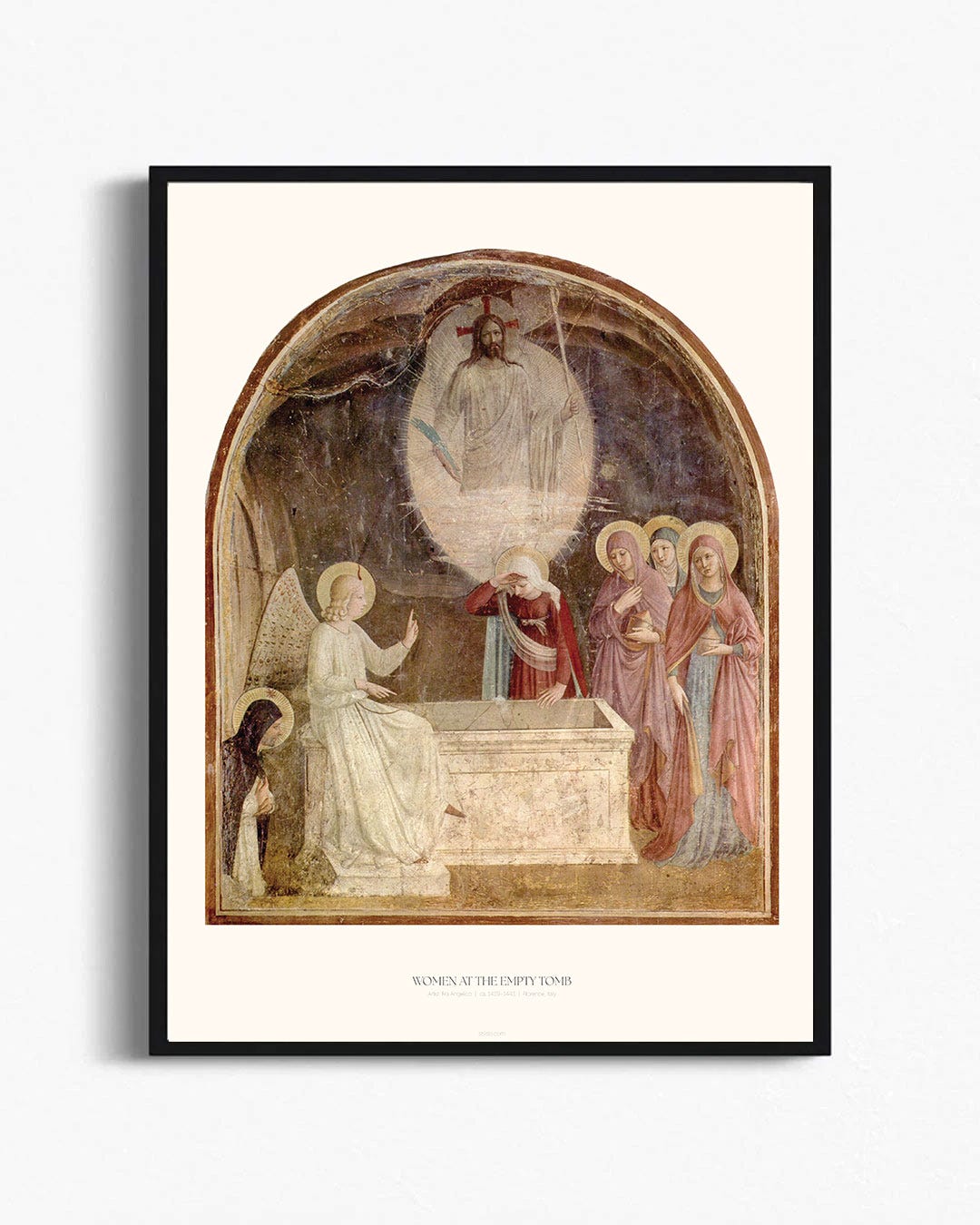
Cell 8, The Resurrection and the Holy Women at the Tomb.
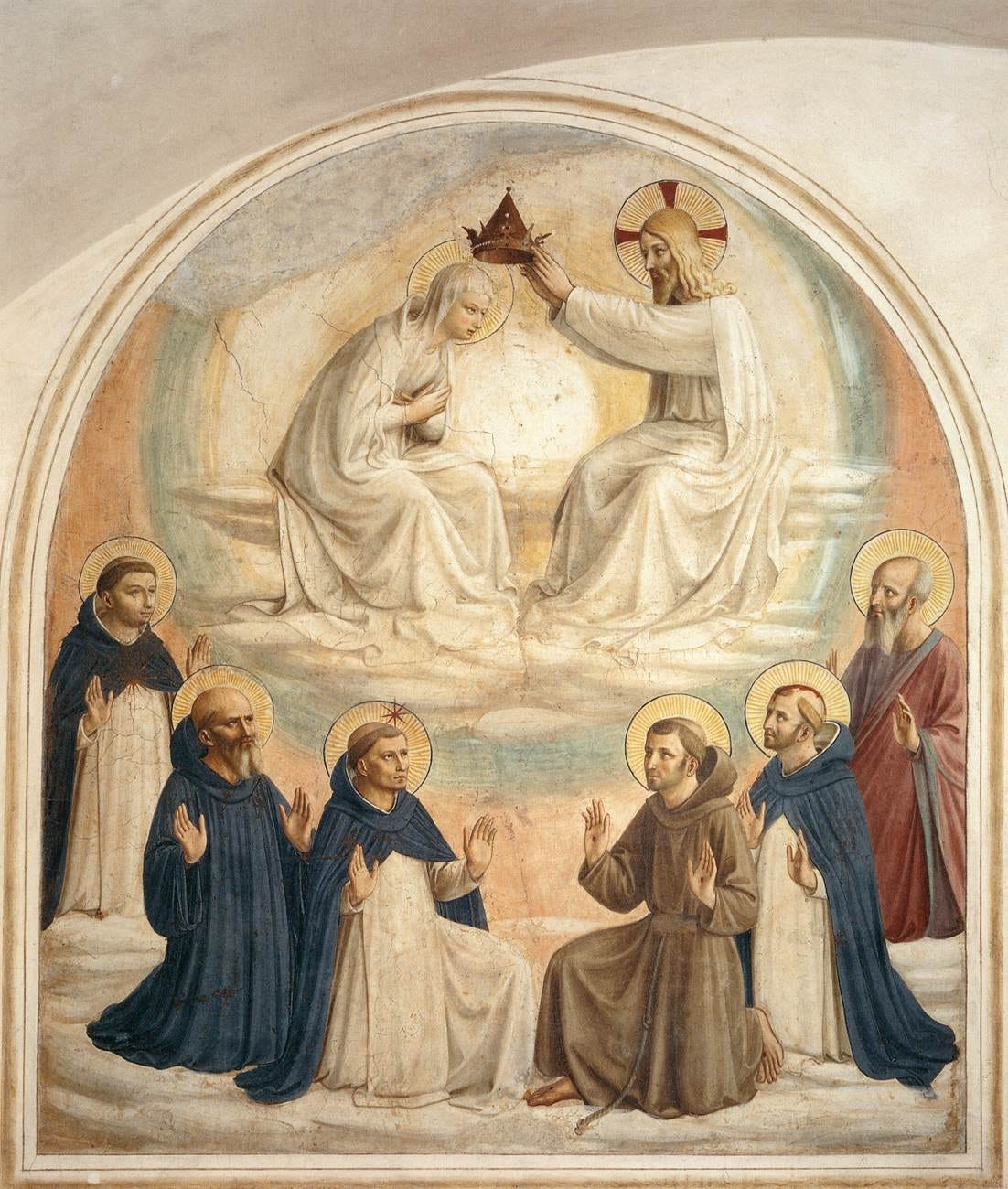
Cell 9, The Coronation of the Virgin. Sometimes called the Maestà, it shows Christ crowning his mother amid a company of saints.
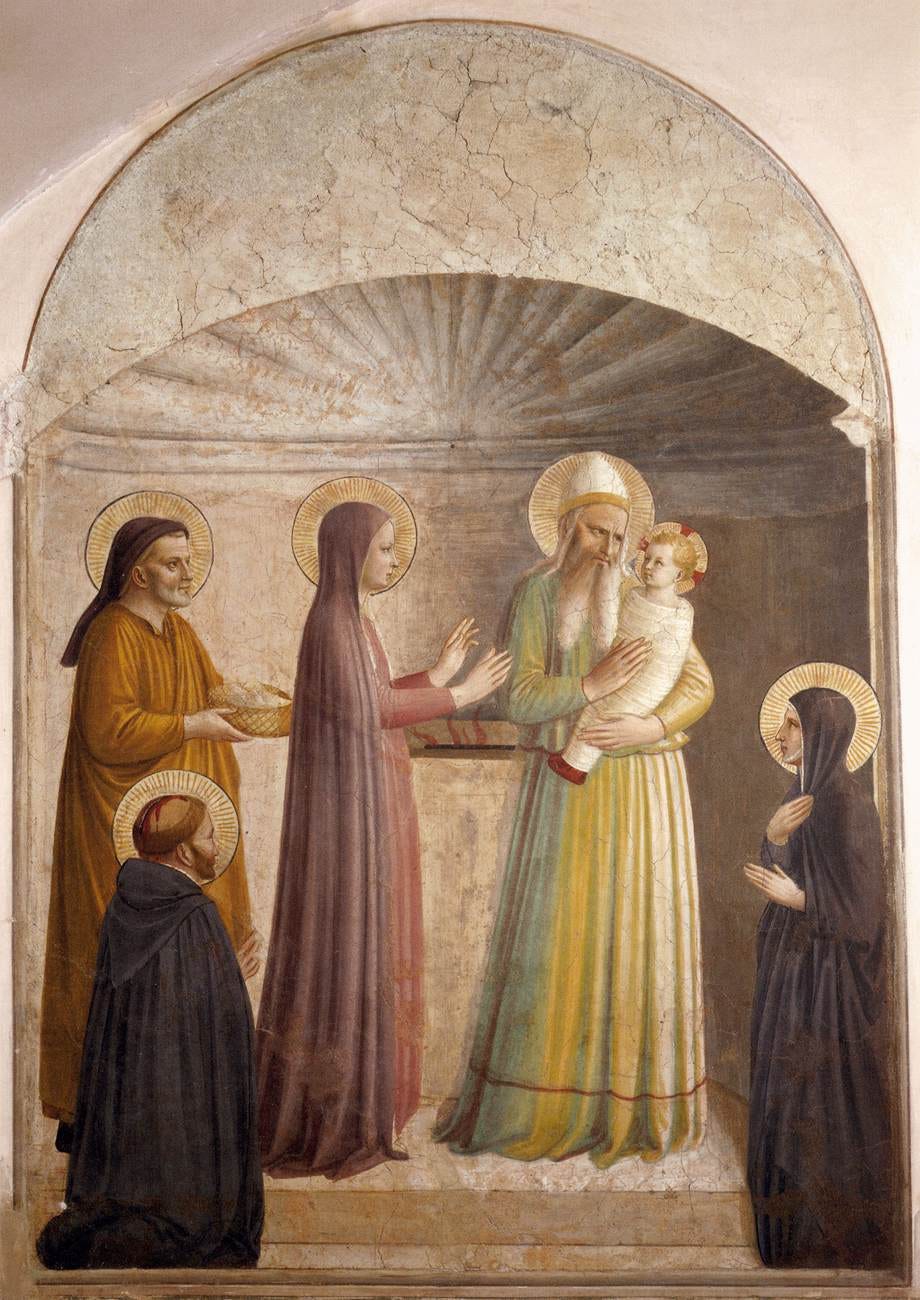
Cell 10, The Presentation of Christ in the Temple. Restoration work revealed that cells ten and eleven were originally connected, with cell eleven continuing the theme through the Virgin and Child among further saints.
Further along, the frescoes shift register. The passageways themselves hold additional works: a large crucifix attended by Saint Dominic, and a Madonna and Child known as the Madonna of the Shadows, set between two cells. It features several saints dear to the Dominicans alongside Saints Cosmas and Damian, the Medici family’s own patrons. This last detail is a quiet reminder that even a convent built for silence and poverty carried the fingerprints of its wealthy Florentine benefactors.
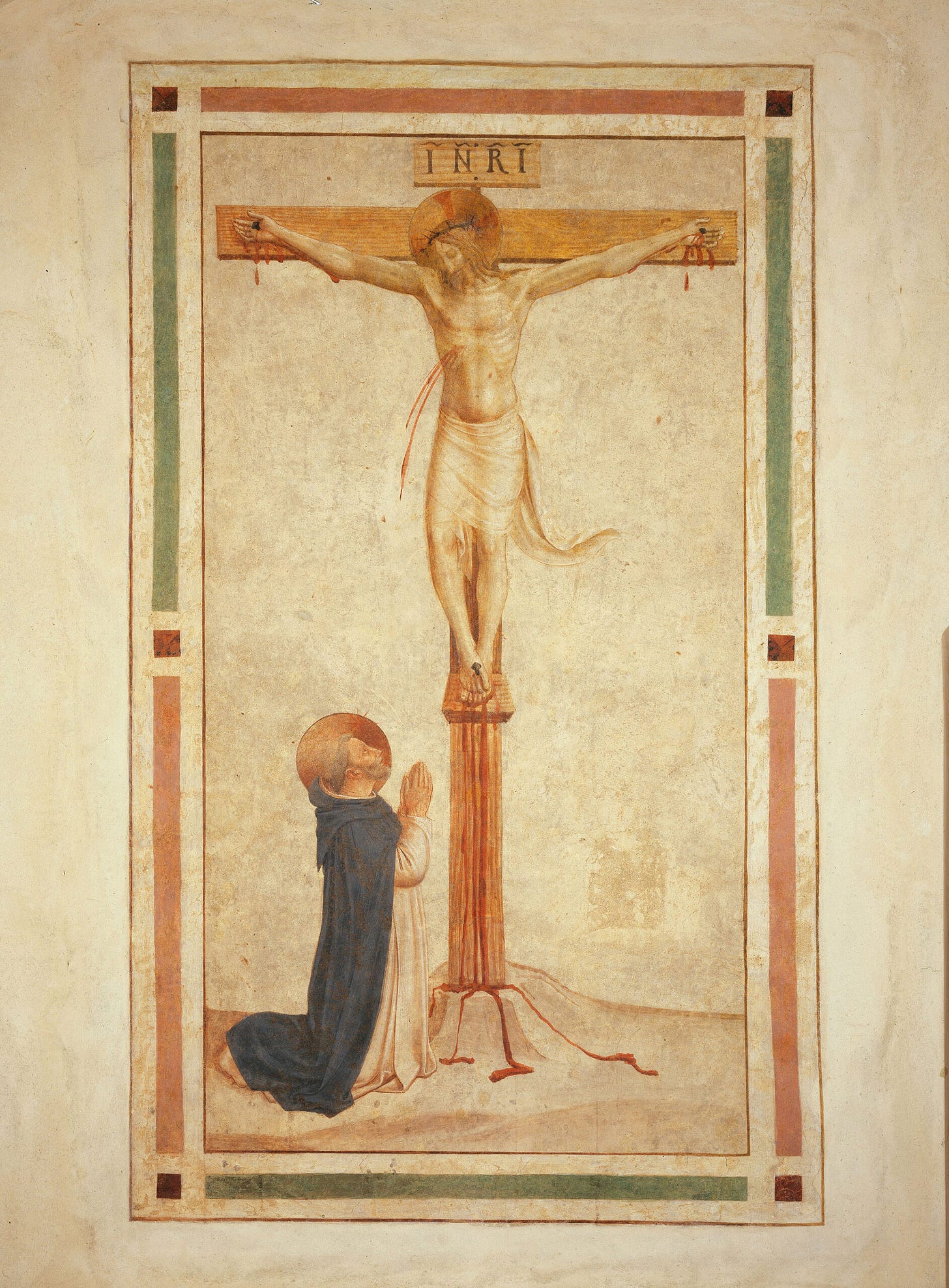
Deeper into the dormitory, in the cells reserved for the novices, rooms fifteen through twenty-one, the recurring image is Saint Dominic embracing the crucifix, painted around 1442. It was a devotional scene the young friars would have passed every single time they left their rooms. Art historians have noted how insistently the blood of Christ is emphasised across this stretch of the corridor: small, deliberate, repeated wounds meant to press the reality of the Passion into men only beginning their religious life.
Elsewhere in the dormitory, cell twenty-five holds a Crucifixion with the Virgin, Mary Magdalene and Saint Dominic. Cell thirty-one contains the unusual and moving Christ in Limbo, showing the Harrowing of Hell. Cell forty, set aside for a lay brother rather than an ordained friar, carries its own Crucifixion with the three Marys and Saint Dominic.
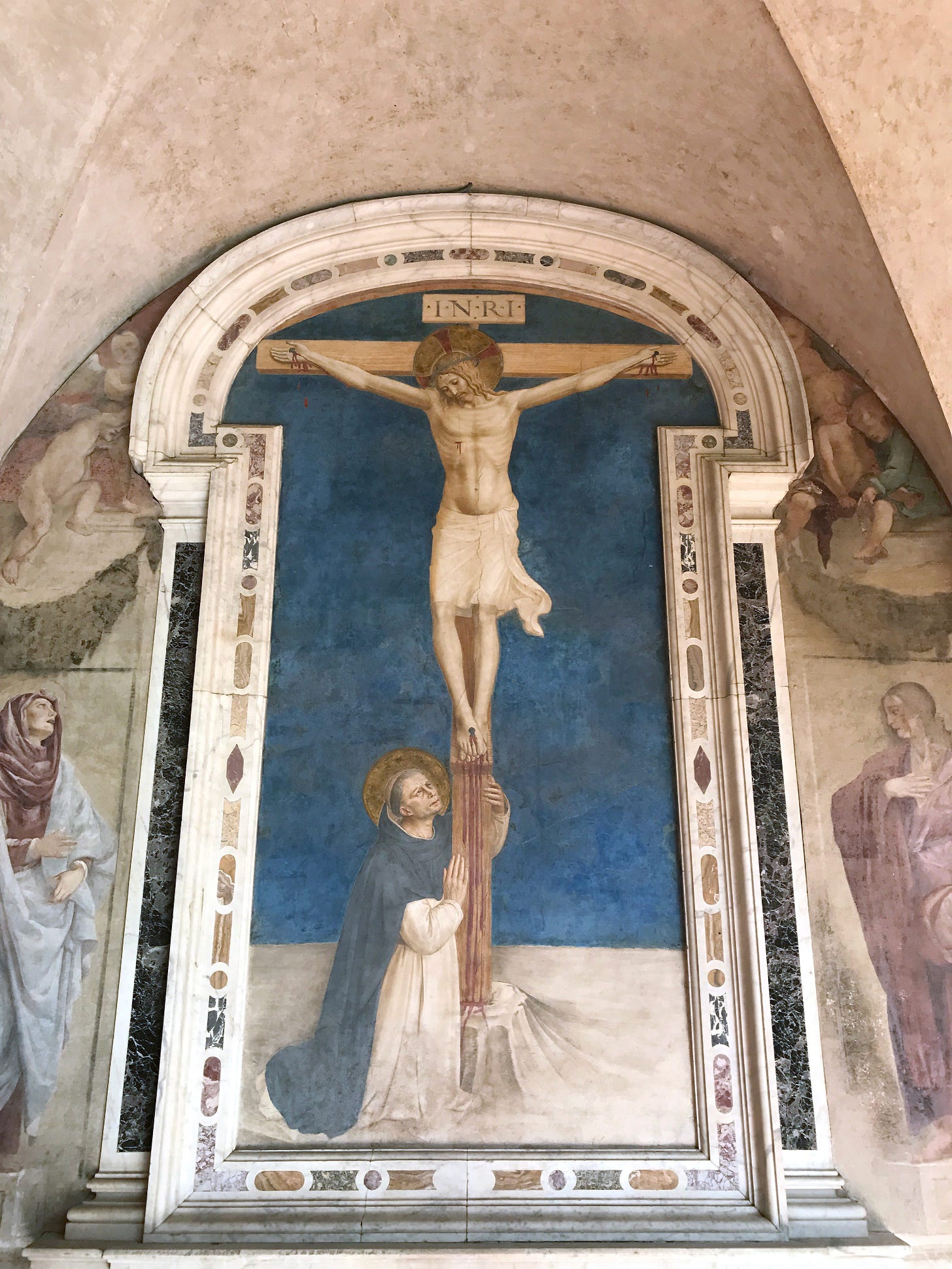
Presiding over the whole convent, in the chapter house where the community gathered for its daily business and correction, Fra Angelico placed his great Crucifixion. It is a work suffused with the same contemplative, melancholic spirituality that marks the Dominican tradition at its best.
A painter who prayed with his brush
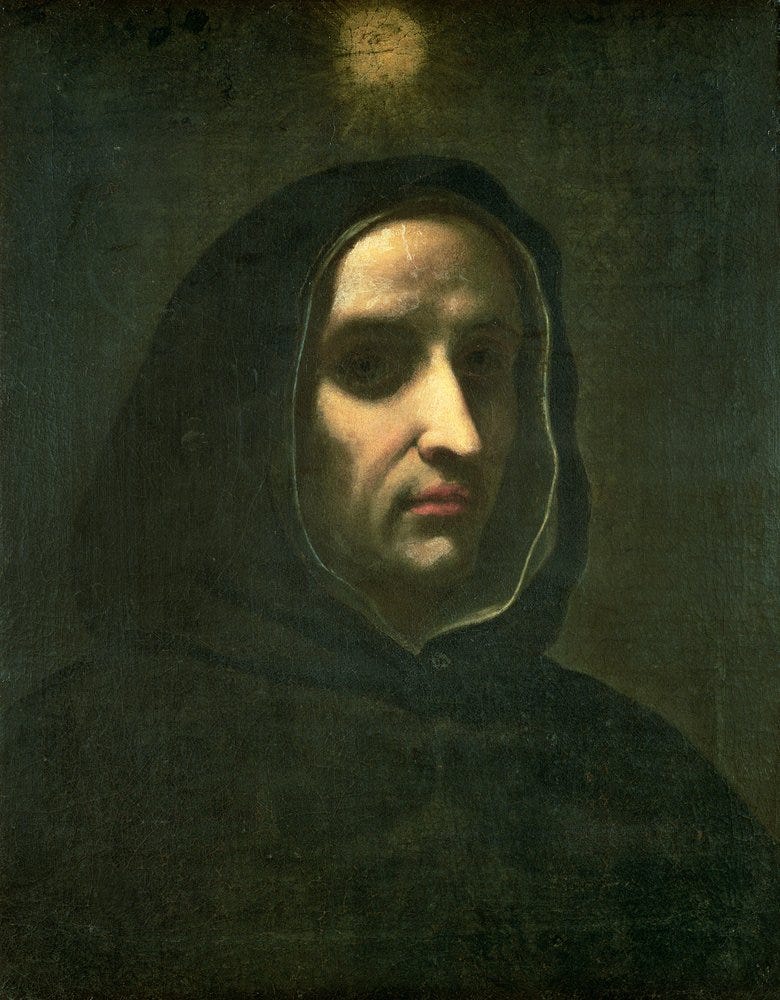
For a Catholic reader, it’s worth pausing on who Fra Angelico actually was, beneath the reputation. He entered the Dominicans as a young man in Fiesole, trained first as an illuminator of manuscripts and choir books. He was already known in his own lifetime, even within Italy, by the affectionate nickname “Il Beato,” the Blessed One. Vasari, writing barely a century later, recorded that he was gentle and temperate and lived chastely apart from the world’s entanglements. He held that anyone occupied with the things of Christ ought to remain with Christ always. He also wept openly whenever he painted a crucifixion, which is perhaps why his crucified and suffering Christs feel so unguarded even today.
That reputation for sanctity was eventually made official. Pope John Paul II beatified Fra Angelico in 1982. Two years later he declared him patron of artists, particularly painters. In doing so, the Pope pointed to the perfect integrity of Fra Angelico’s life and the almost divine beauty of the images he painted, especially his images of the Virgin Mary. Asked what miracles might be attributed to a man being raised to the altars, John Paul simply pointed to the paintings themselves and said: these are his miracles. His feast day is kept on the eighteenth of February.
Why the cells still matter
What the cells of San Marco preserve, more than any other surviving fresco cycle of the period, is the union of art and prayer at the level of a single human cell. Each friar who lived there did not visit a masterpiece. He lived inside one, letting the same image of the Nativity or the Transfiguration or the Noli me tangere work on his imagination through years of ordinary, hidden religious life. For a Catholic visitor today, walking that same corridor is less like touring a gallery and more like retracing the private devotions of men who have been dead for nearly six hundred years, and finding those devotions still legible, still quietly asking to be prayed with rather than merely admired.
Bring the Cells Home
If these images have stayed with you, we’ve released a poster collection drawing directly from Fra Angelico’s cell paintings at San Marco, from the Annunciation to the Transfiguration and the Coronation of the Virgin. Each print offers a way to keep one of these small, quiet devotional scenes in view day to day, much as the friars who first lived alongside them did. You can browse the full collection here.
0 comments